![leaddesk_logo_black.png]](https://onboard.leaddesk.com/hs-fs/hubfs/LeadDesk%20Logo%20and%20Symbol/leaddesk_logo_black.png?height=31&name=leaddesk_logo_black.png)
In your Admin account:
- Go to the Inbound page.
- Go to the Queues subpage.
- Click the Create message channel queue button.
Settings
In the Settings section:
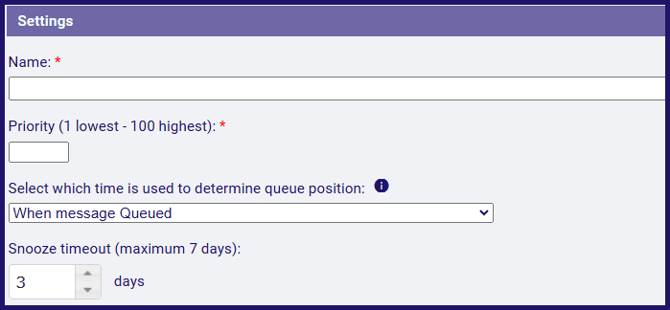
- Type a Name for your queue.
- Type a Priority. This is a value from 1 to 100, with 100 being the highest priority. If calls or messages are waiting from two different queues, the next to be offered to an agent will come from whichever queue has the highest Priority value. This can result in an email being prioritised above a call.
- Click the drop-down list to Select which time is used to determine queue position.
To understand this last option, imagine a queue with multiple messages waiting in it. The agent is offered one of the messages but rejects it. The rejected message re-enters the queue, becoming the most recent message to be queued.
- If you have selected When message Queued, the rejected message will go to the back of the queue as its requeue time is now the latest.
- If you have selected When message Arrived, the rejected message will go to the front of the queue again as its original arrival time is still the earliest.
- Snooze timeout allows you to set the default duration if an agent snoozes a conversation (removing the conversation from their active contacts until the duration finishes, or a new message arrives from the customer). The maximum timeout allowed is 7 days.
Redirections
In the Redirections section you can specify what happens if you cannot handle a message. Redirections will send the message to be handled by a flow, so you would need to have flows to use these features.
- If you want to use a timeout for your Omni queue, click to tick Activate timeout.
- If you have activated timeouts, you can then specify how long a message waits before the timeout applies. Type a number for hours, minutes or seconds. The shortest valid timeout is 10 seconds, the longest is 1000 hours.
- Click the If timeout is reached redirect to drop-down list to select which flow handles the message if it times out.
- If there are no agents currently set to active for inbound, you can have another flow handle the message. Click the drop-down list at the bottom of this section to choose a flow, otherwise the default option leaves the contact in the queue.
Webchat welcome message
The Webchat welcome message section lets you choose a welcome message to send to the customer when an agent accepts a message from that queue.
- Welcome messages are intended for use in webchat, saving agents time by having a standard, professional greeting at the start of each conversation.
- The webchat welcome message can include tags like {agent.name} to personalise the greeting to the agent.
- The welcome message uses a webchat message template.
- The welcome message will be sent in reply to any message the agent accepts, regardless of type. If you would rather the welcome message not be sent to customers contacting you via email, say, you should create separate queues, one with the welcome message that handles webchats, one without that handles emails.
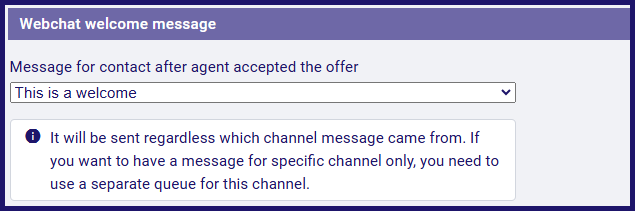
To select the welcome message to use, in the message channel queue settings:
- Go to the Webchat welcome message section.
- Click the Message for contact after the agent accepted the offer drop-down list and select the template to use. Reminder, you will only see the Webchat message templates in this drop-down.
Queue skills
In the Queue’s skills section:
- Click to tick the checkboxes for the skill or skills the agents will need to serve this queue.
Categories
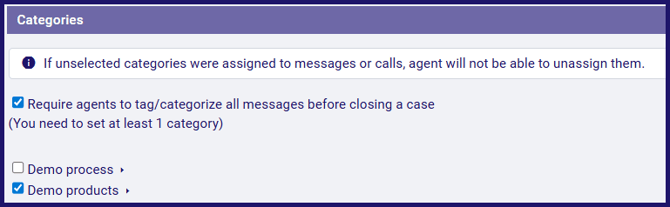
If you are using categories, this is where you select the categories that will be available to agents taking messages from this queue.
- If you want your agents to categorise every message before they can assign an outcome to a conversation, click to tick the checkbox Require agents to...
- Click to tick which groups of categories you wish to be available to agents serving this queue.
Time limits
Optionally, you can notify agents if conversations in their Active list have overdue actions. You can set time limits for the agent to apply categories (if you are using them), respond to the conversation, or add notes.
If the time limit is breached, the agent will see that conversation turn red in their Active list, reminding them to take action. It should be noted that the time limits are in relation to when the conversation arrived in the queue, not arrived with the agent, so it is possible for the agent to accept an offered conversation and for it to immediately show as overdue.
- Click to tick the check-boxes for the time limits you wish to use.
- For each, set a number of days, hours and/or minutes as the time limit.

Creating the queue
When all the appropriate options have been selected:
- Click the Create button.